
A short family riddle can be surprisingly tricky. There are no complicated equations, and every number is small enough to count in your head. Yet a few carefully chosen words can lead readers to very different answers.
Here is the puzzle:
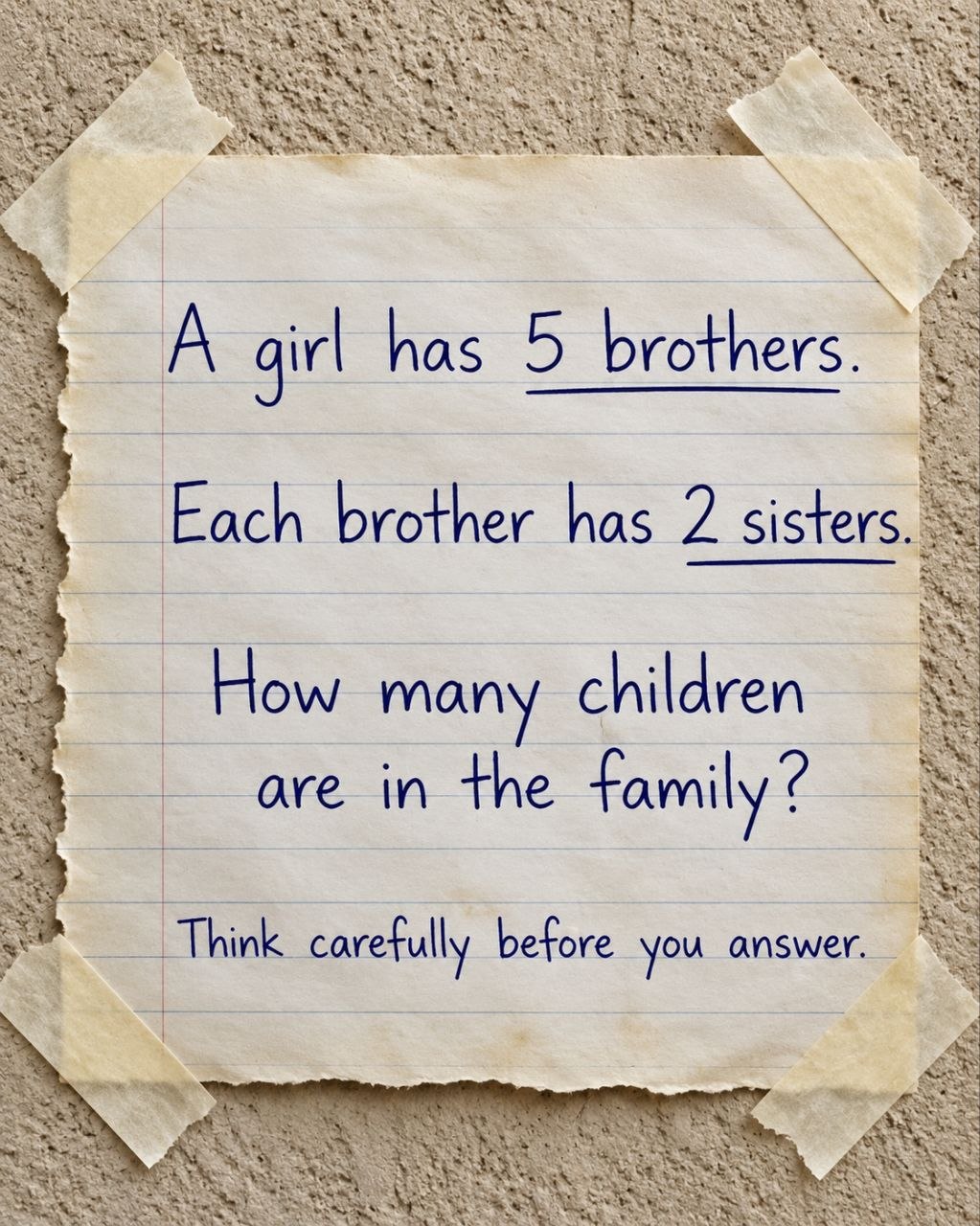
A girl has 5 brothers. Each brother has 2 sisters. How many children are in the family?
Read it slowly before choosing your answer. The challenge is understanding who has already been counted and which people share the same relationships.
The answer and explanation are at the end.
Start With What You Know
The opening sentence introduces a girl and tells us that she has five brothers.
That gives us a clear starting point. However, it does not say that she is the only girl in the family. It tells us how many brothers she has, while leaving the question of sisters open.
This is an important detail. When solving a riddle, it is easy to fill in missing information without noticing. You might imagine one girl surrounded by boys, even though the sentence never says that there are no other girls.
Stick to what the words actually tell you.
Pay Attention to the Word “Each”
The next sentence says:
“Each brother has 2 sisters.”
The word “each” often encourages us to multiply. In many ordinary math problems, that is exactly the right approach.
For example, if five children each have two separate notebooks, multiplication gives the total number of notebooks.
But family relationships require a different kind of attention. Several people can share the same sibling. Before multiplying anything, consider whether the sentence introduces new people or describes relationships among people in the same family.
Keep Track of the Girl Mentioned First
The girl at the beginning should stay in your mental picture throughout the puzzle.
A person can be described in more than one way. Someone introduced as “a girl” can also be described later as a brother’s sister. A change in wording does not necessarily mean that another person has entered the story.
Ask yourself where the original girl belongs when you read the second sentence. Does the new clue include her, or does it describe people in addition to her?
This is where careful reading becomes more useful than quick arithmetic.
Picture One Family
Under the usual interpretation of this riddle, all the children belong to the same sibling group.
Try imagining them standing together for a family photograph. The brothers are not being described as members of five separate families. They share their family relationships.
You can also sketch simple circles on a piece of paper. Add a circle only when the wording requires another child. If a clue refers to someone already represented, use that existing circle.
This helps you avoid counting a person twice simply because the riddle mentions them in two different ways.
Notice Exactly What the Question Asks
The final question is:
“How many children are in the family?”
It asks for children, so parents and other adults do not belong in the calculation.
That may seem obvious, but changing just one word can change a puzzle. A question about “people” would require us to consider who else is included. A question about “children” gives us a narrower task.
Before you settle on an answer, check that you have counted only the group the question asks about.
Check Your Reasoning Against Both Clues
A good answer should satisfy every sentence.
Take the family you have imagined and ask:
- Does the girl have exactly five brothers?
- Does every brother have exactly two sisters?
- Have you counted anyone more than once?
- Have you added anyone the riddle does not require?
If your imagined family fails one of those checks, reconsider how you interpreted the relationships.
The goal is to find one consistent family arrangement that fits both clues, rather than performing a calculation with every number you see.
Make Your Final Guess
Before continuing, choose your answer.
Then try explaining it in one sentence. If you can describe who the children are and how they are related, you are more likely to have solved the puzzle than if you simply multiplied the numbers.
Ready to check?
The Answer: 7 Children
There are 5 boys and 2 girls, making 7 children altogether.
All five brothers share the same two sisters. The girl introduced in the first sentence is already one of those sisters, so only one additional girl is needed.
That gives us:
5 brothers + 2 sisters = 7 children.
We do not multiply five by two because each brother is referring to the same pair of sisters. We also do not add the original girl again, because she is already included among the two girls.
The correct answer is 7 children.