
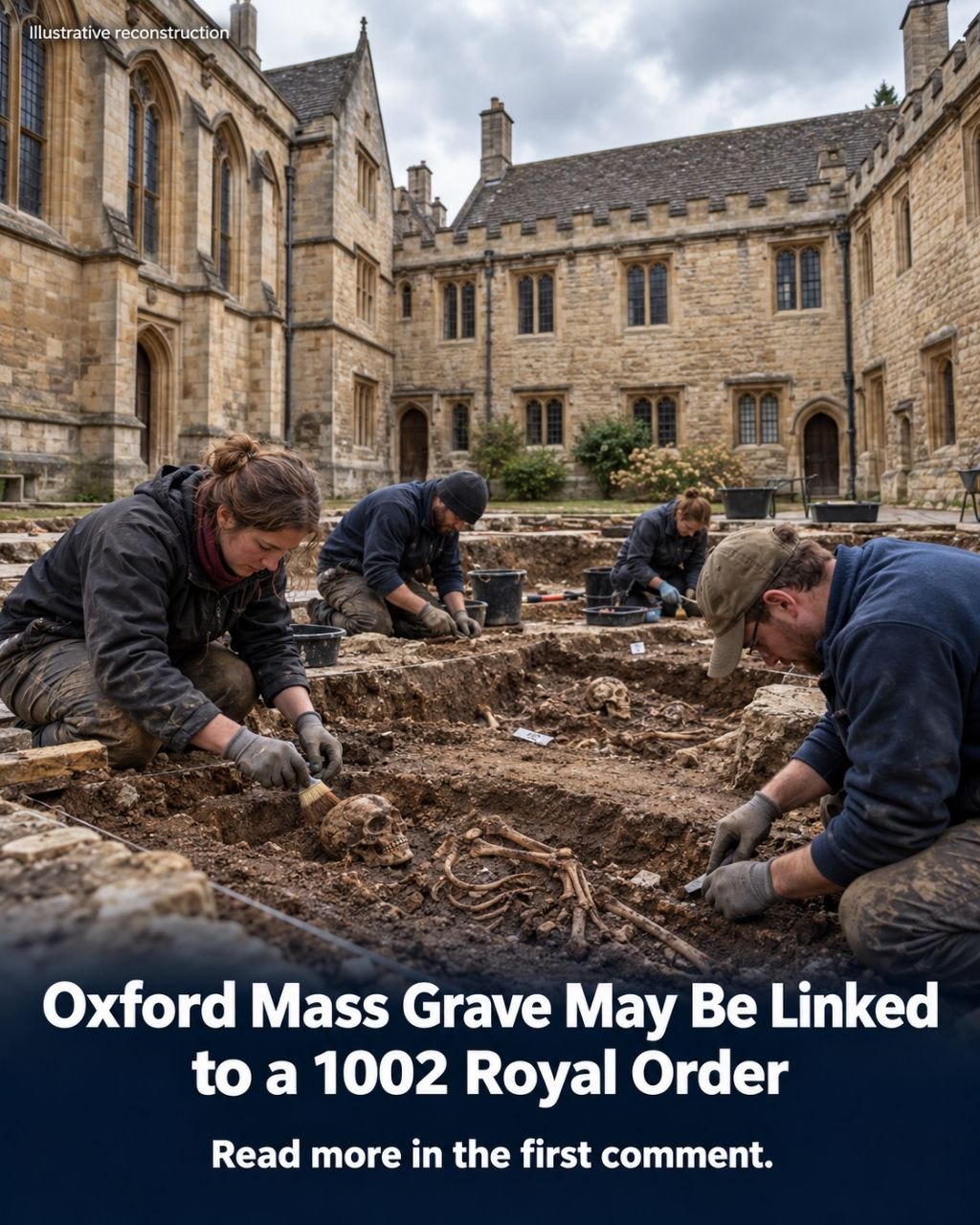
Construction work at St John’s College in Oxford led to a disturbing discovery in 2008: a burial pit containing the remains of roughly three dozen young men.
Many had suffered violent injuries. Researchers later suggested that the grave could be connected to the St Brice’s Day massacre of 1002, when King Æthelred ordered the killing of Danes living in England.
A Violent End
Most of the men were estimated to have been between about 16 and 25 years old. Their skeletons showed evidence of sharp-force injuries and severe damage to the skulls. Some bones also showed signs of burning.
The findings pointed to a violent episode, but identifying the victims and explaining their deaths required more than an examination of their injuries.
The Possible Connection to 1002
Radiocarbon dating placed the burial between approximately AD 960 and 1020. That range includes November 1002, when Æthelred issued his order against the Danes.
A royal charter from 1004 provides another possible connection. It describes Danes taking refuge in a church in Oxford, which was then burned down. The account has drawn particular interest because some of the remains also showed evidence of exposure to fire.
These similarities make the massacre a plausible explanation. However, the dating range is too broad to establish the exact year of the deaths.
Clues From the Men’s Diet
Isotope analysis suggested that the men had eaten a diet rich in marine protein. Researchers considered this consistent with a Scandinavian upbringing, rather than a typical diet in inland England.
That evidence supports the possibility that the victims were Danes or had Scandinavian connections. It does not, by itself, establish their nationality or explain why they were killed.
What the Grave Can Tell Us
The connection to the St Brice’s Day massacre remains a subject of scholarly discussion. The injuries, dating, dietary evidence, and written account fit together, but they do not prove that the men died during the events of 1002.
If the interpretation is correct, the Oxford grave offers rare physical evidence of an episode otherwise known mainly through historical documents. Even with questions still unanswered, the discovery brings the human cost of that period into sharper focus.